
-
The Rise of Political Violence in America
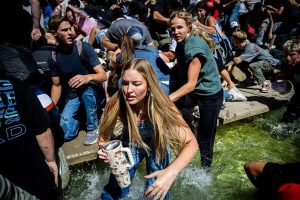
College Students Scramble for Cover
On September 10, 2025, conservative commentator and Turning Point USA cofounder Charlie Kirk was shot and killed while speaking at Utah Valley University in Orem, Utah. Twenty minutes into his event, a single shot from a nearby building struck him in the neck, sending the audience into panic as police rushed in. Two days later, authorities arrested 22 year-old Tyler James Robinson. Prosecutors say he planned the attack for more than a week, left a written note stating he intended to “take out Charlie Kirk,” and targeted him specifically because of his political views. While headlines focused on the event itself, Kirk’s assassination reveals deeper issues connected to political violence, radicalization, public event security, and the nation’s polarized climate. These broader issues give this moment its kairos, its urgency, because Kirk’s death is not just a tragedy but a warning about where American politics is heading.
Research shows that political violence in the U.S. has been rising. A 2022 Pew Research Center study reported that four in ten Americans believe political violence may be justified under certain conditions, a number that has increased alongside polarization. This shift helps explain how individuals like Robinson may come to see violence as a legitimate response to political disagreement. Another study from the Brookings Institution (2023) highlights how online spaces contribute to radicalization by amplifying narratives that portray political opponents as existential threats. These findings show that Kirk’s assassination was not an isolated act; it reflects patterns that experts have documented for years.
The allegations in Robinson’s case match the warning signs outlined by the U.S. Department of Homeland Security’s 2023 Threat Assessment, which describes how individuals with personal grievances and ideological motivations often act alone but consume online content that intensifies their beliefs. For example, Luigi in the UNH incident and Trump’s attempted assassination both came from people with deep hatred. DHS notes that these “lone actors” are the hardest to detect and often move from anger to violence suddenly. Suppose Robinson was influenced by these kinds of dynamics. In that case, Kirk’s death becomes part of a larger picture: a political environment where extreme rhetoric, misinformation, and social division can push vulnerable individuals toward violent action.
Kirk’s assassination also raises concerns about public events and campus security. Colleges are designed to be open spaces, but that openness creates weaknesses. The fact that someone could fire from a nearby building into a crowded university event shows that traditional event security cannot always protect against long-range threats. Universities now have to consider whether certain buildings need to be restricted during high-profile visits, whether speakers should be placed in more secure venues, or whether law enforcement risk assessments should become standard practice. In a politically tense environment, the traditional model of open campus accessibility may no longer be realistic.
Another major issue this event forces into view is the role of political rhetoric. Across media platforms, politicians and commentators use increasingly extreme language to energize supporters. Opponents are described as corrupt, dangerous, or even enemies of the country. When rhetoric escalates like this, individuals who are already isolated or emotionally unstable may interpret political messaging literally. This does not mean political speech is responsible for violent acts, but it shows how the tone of public discourse contributes to a climate where violence becomes thinkable.
Corruption is constantly on the rise, especially in politics, and this incident makes it significantly clear. Kirk’s assassination exposes issues of radicalization, rising political violence, security gaps, and rhetorical escalation. It also begs the question of whether or not experts can help make sense of these issues. The Pew Research Center, the Brookings Institute, and the Department of Homeland Security help clarify the issues by providing context and data. There is no moment more timely than now to consider America’s future, when a nationally known political figure was assassinated during a public speech on a college campus.
Ultimately, Charlie Kirk’s death is more than a shocking news event. It is a direct signal that political violence in America has reached a dangerous new stage. If the country does not address the conditions that led to this moment, including radicalization, rhetoric, polarization, and weak security at public events, then incidents like this may become more common. The country must recognize the importance of this moment before political violence becomes something Americans simply learn to live with.
Sources
Pew Research Center. “Americans Say Politically Motivated Violence Is Increasing and They See Many Reasons Why.” Pew Research Center, October 23, 2025. https://www.pewresearch.org/short-reads/2025/10/23/americans-say-politically-motivated -violence-is-increasing-and-they-see-many-reasons-why/
Brookings Institution. “Political Violence in the U.S.: How Radicalization and Online Spaces Contribute.” Brookings Institution, 2023. https://www.brookings.edu/articles/political-violence-in-the-us/
U.S. Department of Homeland Security. Homeland Threat Assessment 2024-25. Washington, D.C.: DHS, 2023. https://www.dhs.gov/sites/default/files/2024-10/24_0930_ia_24-320-ia-publication-2025- hta-final-30sep24-508.pdf
